
From 'Furnace' to 'Renovation': Vietnam's Political-Economic Transition and Future Challenges
Introduction
In 2024, Vietnam's political scene drew global attention due to a sweeping 'furnace' anti-corruption campaign. From the state president to the National Assembly chairman, several top officials resigned over 'political responsibility,' followed by the death in office of Communist Party General Secretary Nguyen Phu Trong, with state president To Lam taking the helm. To international observers, these changes added new uncertainty to Vietnam's 'Renovation' (DOI MOI) cause. However, To Lam has explicitly promised that Vietnam's political and economic policies will remain stable and reform will not pause.
Vietnam's 'Renovation' began in 1986 as a systematic transformation of internal reform and external opening, aiming to build a socialist-oriented market economy. Over more than three decades, this policy turned Vietnam from an economy on the brink of collapse due to war and isolation into one of the world's fastest-growing economies. Yet the path has not been smooth: economic structural over-reliance, lagging infrastructure, labor skill bottlenecks, endemic corruption, and environmental costs remain deep challenges constraining its march toward high-income status.
Understanding Vietnam's achievements and difficulties today requires tracing its historical depth and examining the gains and losses of its 'Renovation' from a global perspective.
I. Historical Backdrop: From 'A Thousand Years of County Rule' to the Launch of Renovation
Vietnam's history is an epic of constantly seeking balance between resistance and integration. According to scholars Vu Hong Lien and Peter Sharrock of the University of London in their book 'Descending Dragon, Rising Tiger: A History of Vietnam,' the Red River Delta was inhabited as early as the Paleolithic era. From the Qin and Han dynasties onward, northern Vietnam was under the direct administration of successive Chinese dynasties, deeply rooting Han culture there. After gaining independence from China in the 10th century, Vietnam experienced the rise and fall of autonomous dynasties while maintaining a character of both absorbing Chinese civilization and asserting self-reliance.
In the mid-19th century, French colonial gunboats shattered this order. After the Sino-French War, Vietnam became part of French Indochina. During World War II, Japan replaced France as the dominant power. Following the August Revolution in 1945, Ho Chi Minh proclaimed the Declaration of Independence at Ba Dinh Square in Hanoi, giving birth to the Democratic Republic of Vietnam. The subsequent 30-year wars against France and the United States shaped Vietnam's resilient modern spirit. In 1975, Saigon was liberated; in 1976, the country was unified. But wartime highly centralized planning and extreme ideology plunged the new nation into a severe economic crisis, with inflation once reaching 500%.
In 1986, the Sixth National Congress of the Communist Party of Vietnam decided to follow China's reform and opening-up model, implementing the transformation policy called 'Renovation' (Doi Moi). This marked a shift from ideological primacy to economic development as the central task, opening a new era of integrating into the international system and reshaping the nation's destiny.
II. The Core of Renovation: From Planned Economy to Socialist-Oriented Market Economy
French scholar Tran Thi Anh Dao, in 'Rethinking Asian Capitalism,' systematically outlines the specific content of the Renovation policy, centered on the twin drivers of economic liberalization and opening to the outside world.
Domestically, the Vietnamese government greatly relaxed administrative control over the economy, allowed private enterprises and foreign capital in, broke the absolute monopoly of state-owned enterprises, and shifted to market-based resource allocation. In agriculture, a landmark 'land contract' reform granted farmers long-term stable land-use rights, greatly unleashing agricultural productivity. State-owned enterprises underwent two major rounds of restructuring and shareholding reform to establish modern corporate systems and improve operational efficiency.
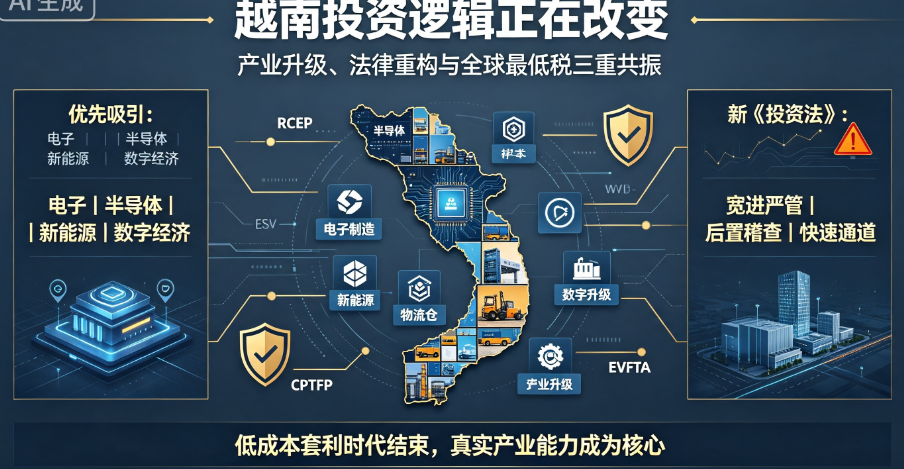
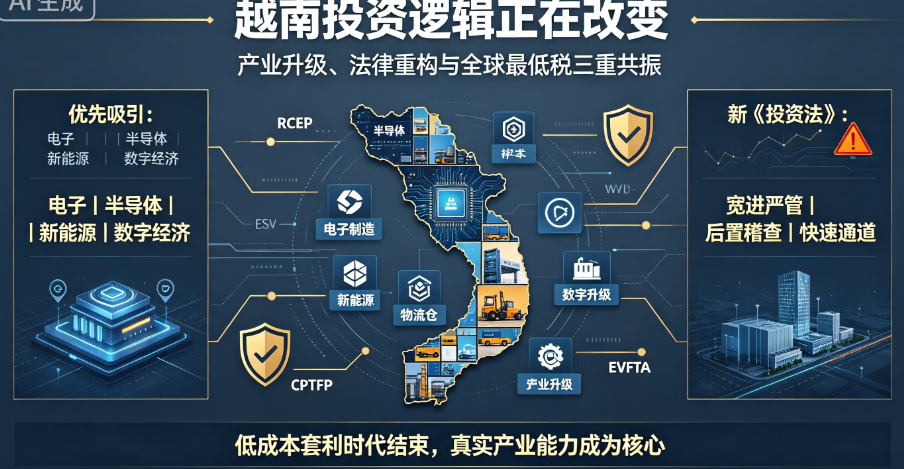
Externally, Vietnam actively expanded diplomatic space, joining ASEAN in 1995 and the WTO in 2007, and subsequently deeply engaging in RCEP and CPTPP. These moves transformed Vietnam from a Cold War peripheral state into one of the 'new Asian tigers.'
The reform results are striking. Over the past decade, Vietnam's GDP has grown at an average annual rate of 6%–7%, showing strong resilience even under global economic downturn. The economic structure has undergone qualitative change: industry and services have replaced agriculture as growth drivers. Leveraging labor cost advantages and open policies, Vietnam rapidly became a major global manufacturing and export base for electronics, garments, and footwear, successfully attracting large inflows of foreign direct investment (FDI), injecting capital, technology, and management expertise into the economy.
III. The Flip Side of Prosperity: Structural Challenges and Governance Difficulties
Yet prosperity casts a shadow. Vietnam's Renovation achievements have been concentrated in quantitative expansion, while qualitative improvement remains weak.
Economic structural over-reliance is the primary contradiction. Vietnam's economy depends heavily on exports and foreign investment, with a weak domestic market. Manufacturing is concentrated in the middle-to-low end of global value chains, yielding low added value and high vulnerability to external demand fluctuations and supply chain shifts. Although the government encourages industrial upgrading, breakthroughs in core technology, brand building, and high-end services remain distant.
Infrastructure gaps are equally striking. Despite notable improvements in transport networks in Ho Chi Minh City and Hanoi, nationwide logistics costs remain high, and power supply faces strain during peak demand. Rapid urbanization has overwhelmed major cities with traffic congestion, housing shortages, and sewage problems.
Labor quality is a key constraint on industrial upgrading. Vietnam's nine-year compulsory education enrollment rate is high, but vocational training and higher education lag behind economic needs, leading to severe shortages of skilled workers and innovative talent. As the demographic dividend fades, this bottleneck will become more acute.
Moreover, corruption and environmental pollution constitute a dual erosion. Although the powerful 'furnace' anti-corruption campaign since 2022 has brought down many senior officials and somewhat purified the political ecosystem, inefficient administration, damaged judicial credibility, and a 'shadow economy' remain perceived as potential risks to Vietnam's investment climate. Meanwhile, air, water, and soil pollution from rapid industrialization are worsening, forcing Vietnam to make a clearer strategic choice between 'growth' and 'sustainability.'
IV. International Perspectives: Divergent Assessments and Future Prospects
Scholars internationally hold differing views on the historical significance of Vietnam's Renovation.
Chinese scholar Pan Jin'e and others, in 'Vietnam's Renovation and China-Vietnam Reform Comparison,' argue that Vietnam's socialist renovation has been generally successful, with the key lying in upholding Party leadership and correct reform sequencing. She specifically notes that some practices in political system reform and inner-Party democracy offer instructive cases for exchange and mutual learning between the Chinese and Vietnamese Communist Parties.
American veteran Vietnam expert David Elliott, in 'Changing Worlds,' believes that Vietnam swiftly adjusted its diplomatic orientation after the Cold War and deeply integrated into the global economic system without losing its distinctive political identity. This transformative drive did not come from external pressure but from a deep leadership consensus that 'without reform, one falls behind.'
However, Vietnamese local researchers Truong and Dong Vu, in the book 'The Dragon's Belly,' offer a more critical reflection. They note that Vietnam has not earned the title 'Dragon of Asia' because it lacks more far-sighted leadership to escape the dependency trap of 'sitting under a big tree for shade.' Vietnam's economic dependence on both China and the United States is deepening, and endemic corruption and elite infighting in its governance system make future fragility impossible to underestimate.
Conclusion: Finding a Fulcrum Amid Change
Looking back over Vietnam's two millennia of history—from the self-sufficiency of feudal dynasties to the humiliation of colonial rule, the suffering of the Cold War frontline, and today's economic miracle—this nation has consistently shown remarkable resilience and flexibility. As British researcher Bill Hayton put it in 'A Brief History of Vietnam': 'In the past century, Vietnam has experienced the worst that humanity can endure; now one should hope that in the coming years it will enjoy good times.'
The political changes of 2024 represent the ruling party's 'self-purification' as it moves toward a higher development stage. The arrival of the To Lam era may not signal a change in the Renovation path, but rather a hope to break through in 'quality' and 'governance.' Facing structural economic contradictions and severe governance challenges, Vietnam must take more pragmatic action in diversifying the economy, making up for infrastructure deficits, deepening education and science-technology reform, and achieving green development, in order to ensure that the grand Renovation cause truly transitions from 'follower' to 'leader' over the next four decades.
Vietnam's future still depends on whether it can appropriately balance the scales of 'development' and 'governance.' This experiment, which concerns the nation's destiny, is not only vital for Vietnam itself but also provides an important observation model for the modernization process of many late-developing countries.
Keywords: Vietnam; Renovation; economic transition; governance challenges; anti-corruption; sustainable development